
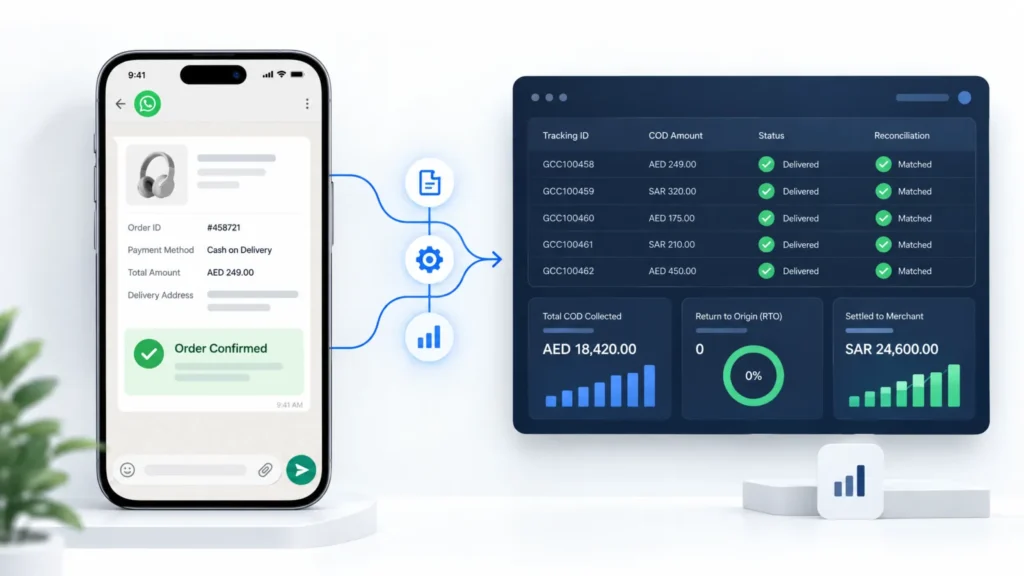
Unverified Cash on Delivery (COD) orders and untracked courier remittances quietly drain profit from GCC e-commerce stores. To reduce COD returns in the GCC and fix Cash on Delivery reconciliation, verify every order before it ships and match every courier payout to an order ID.
COD wins trust with Gulf shoppers, so most brands cannot drop it. The answer is not less COD. It is better-controlled COD.
This guide gives you a five-step framework to cut Return-to-Origin (RTO) parcels, and a four-step routine to reconcile courier payouts. It is written for founders, operations managers and finance leads in the UAE, Saudi Arabia, Qatar, Kuwait, Bahrain and Oman.
Why Cash on Delivery (COD) Creates Hidden Profit Leaks in the GCC
COD leaks profit in two places. One is the parcel that comes back. The other is the cash that never arrives.
The true cost of one RTO parcel
A returned COD parcel costs far more than the postage. You pay for the trip out, the trip back and the work in between.
- Forward shipping: the fee you paid to send the parcel.
- Return shipping: many couriers charge for the journey back.
- COD and failed-delivery fees: where your courier’s rate card applies them.
- Handling: inspecting, repacking and re-shelving the item.
- Blocked inventory: stock that cannot be sold while the parcel travels.
- Wasted ad spend: the Meta or Google click that produced the order earned nothing.
- Damage or loss: parcels that return broken, or not at all.
Add these up for one parcel, then multiply by your monthly RTO count. The total can surprise brands, because each cost sits in a different report.
Peak periods raise the risk. Ramadan, Eid and White Friday tend to bring more impulse COD orders, busier couriers and more unreachable customers.
The second leak: courier COD remittances
Couriers collect cash on your behalf and pay it out later, often as one lump-sum bank transfer. If finance only checks that the transfer arrived, short settlements and missing parcels go unnoticed.
Shipping fees, COD handling charges and VAT deductions all blend into that single number. Without order-level matching, nobody can say which parcels were paid, short-paid or never remitted.
Step-by-Step Framework to Reduce COD Return-to-Origin (RTO) Rates
These five steps work together. Start with the first two, then add the rest as your order volume grows.
Our Order Management Services team runs this workflow daily for GCC brands.
1. Automated WhatsApp Business API & Voice Order Verification
Send a WhatsApp message as soon as the order is placed. Add confirm and cancel buttons, and print the Air Waybill (AWB) only after the customer confirms.
Write the message in Arabic and English, and show the items, the total and the delivery address. Use approved message templates and customer opt-in, as WhatsApp Business API rules require.
For high-value orders or incomplete addresses, add a voice call. A short call catches mistakes that a button press misses, and our Bilingual Customer Support team can make those calls in Arabic and English.
Set a clear rule for silence. If a customer has not confirmed within your chosen window, hold the order and follow up instead of shipping.
2. Address Validation & GCC Location Pinning
Many failed deliveries start with a weak address. Gulf cities do not always use formal street addresses, so couriers often rely on landmarks and phone calls.
Ask Saudi customers for their National Address short code. For the UAE, ask for a Makani number where one exists, plus a clear landmark. Then request a WhatsApp live-location pin before dispatch.
Add these fields to your checkout and reject entries that fail a simple format check. A CRO & Checkout Optimisation review can add them without adding friction for good customers.
3. Incentivising Prepaid & BNPL Checkout Options
Offer Apple Pay, mada and card payments through gateways such as PayTabs and Telr. Add buy-now-pay-later options such as Tabby and Tamara, where your account supports them.
Nudge shoppers; do not force them. Use a small prepaid perk, free express shipping on prepaid orders, or a clear note that prepaid orders ship first.
Test one nudge at a time. Compare COD and prepaid conversion before and after, so you keep only what works.
4. Same-Day Non-Delivery Report (NDR) Escalation
Treat a “customer unreachable” or “address not found” status as a live problem. Do not wait for the parcel to return on its own.
Message the customer on WhatsApp and call them the same day. Then send the courier a clear instruction: reattempt, change the address, or hold.
Our Logistics & Fulfilment Operations team coordinates these reattempts with couriers such as Aramex, SMSA Express, Shipa Delivery, Quiqup and Jeebly.
5. Flagging Repeat High-Risk COD Buyers
Tag customers who repeatedly refuse parcels or cannot be reached. Use your CRM or order system, and base the tag on order behaviour only.
Ask flagged buyers to pay in advance or leave a small deposit. Review the tags regularly, so one past mistake does not block a good customer for ever.
Comparison Table: Unmanaged COD Process vs. Structured GCC COD Operations
| Operational factor | Unverified Ad-Hoc COD Handling | RecommendedVeloris Structured COD & Reconciliation Workflow |
|---|---|---|
| Pre-dispatch verification | Orders ship as soon as they are placed | WhatsApp confirmation, plus voice calls for high-value orders |
| Address accuracy | Free-text addresses, checked by the courier | National Address, Makani or landmark checks and a location pin |
| Failed delivery / NDR recovery | Parcel returns after the courier’s final attempt | Same-day customer contact and a clear courier instruction |
| Courier remittance matching | Lump-sum transfers checked against the bank balance | Every delivered order matched to the courier’s remittance line |
| Net margin visibility | Returns and fees hidden in separate reports | Returns, fees and settlements shown against each SKU |
Swipe sideways to see the full table.
How to Master Order-Level Courier COD Reconciliation
Reconciliation is a weekly habit, not a year-end clean-up. Four steps keep it simple.
1. Match every delivered order ID against courier remittance logs
Download each courier’s COD remittance report from Aramex, SMSA Express, Shipa Delivery or your other partners. Match on order ID or AWB number, not on the bank total.
Mark each order as paid, short-paid or unpaid. That one status shows you where money is missing.
2. Separate shipping fees, COD handling charges and VAT
Record each deduction on its own line. Check how every courier invoices VAT in the UAE and Saudi Arabia, and ask your accountant to confirm the treatment.
3. Track “Delivered but Unremitted” parcels on a weekly ageing report
List every parcel marked delivered whose cash has not arrived. Group them by courier and by age, for example up to 7 days, 8 to 14 days, 15 to 30 days and over 30 days.
Raise queries with each courier on a fixed day every week. Our Business Intelligence & Data Dashboards service can build this report so that it refreshes on a schedule.
4. Sync verified settlements into Zoho Books, Odoo or your ERP
Post each matched settlement against its orders and clear the courier balance. Leave unmatched items open until someone resolves them.
Brands that prefer not to do this in-house can use our Finance & Admin Operations team. Once the routine runs weekly, your SKU margins include real return and settlement costs.
GCC Regional Operations Support: Dubai, Riyadh & Doha
Veloris E-Commerce has active teams in Dubai, Riyadh and Doha. They manage daily COD verification, courier coordination and order-level financial reconciliation for retail and wholesale brands across the Gulf.
Our Dubai team supports operations in the UAE. Our Riyadh team covers Saudi Arabia, including National Address checks, and our Doha team supports Qatar.
Brands in Kuwait, Bahrain and Oman work with the same regional teams. You get one accountable partner instead of a separate vendor in every market.
Frequently Asked Questions About COD Returns and Courier Reconciliation
Should GCC e-commerce stores stop offering Cash on Delivery (COD) to avoid returns?
No. COD still builds trust with many Gulf shoppers, so removing it can cost you sales. Verify orders, add prepaid and BNPL options, and flag repeat non-collectors; stop COD only for specific risky orders or customers.
How quickly should a COD order be verified before dispatching to the courier?
Send the WhatsApp confirmation straight after the order is placed. Give the customer a clear window that fits your delivery promise, and ship only after they confirm. Call high-value orders and incomplete addresses the same working day.
How do you reconcile COD settlements across multiple GCC courier companies?
Keep one master ledger, in a sheet or your ERP, keyed on order ID. Import each courier’s remittance report on its own schedule, match every line, and record fees and VAT separately. Review a weekly ageing report for each courier so unpaid parcels surface early.
Can BNPL options like Tabby and Tamara help reduce Cash on Delivery dependency?
They can. With Tabby or Tamara the provider pays you, so the order no longer depends on cash collected at the door. Approval rests with the provider and not every shopper will qualify or choose it, so keep verified COD available.
Book a free operations and reconciliation audit
We will review how you verify COD orders, handle failed deliveries and match courier payouts. You receive a short list of fixes, in order of impact, with no obligation.
Our teams in Dubai, Riyadh and Doha support brands across the GCC.
Book My Free Audit →Editorial note: This article gives general operational guidance for e-commerce businesses. It is not legal, tax or financial advice. Courier terms, VAT treatment, messaging rules and platform policies differ by country and change over time, so confirm the details with your courier, accountant and legal adviser.
Comments
No comments yet. Share your thoughts below.